Quick answer
Strabismus, commonly called a squint, is a misalignment of the eyes in which one eye turns in, out, up or down while the other looks straight ahead. It affects around 3% of children and also occurs in adults. In children it can cause amblyopia; in adults it often causes double vision. It is treated with glasses, prisms or squint surgery.
What is Strabismus (Squint)?
Strabismus — commonly called a squint — is a condition in which the two eyes are not aligned and do not point in the same direction simultaneously. One eye may turn inwards (esotropia), outwards (exotropia), upwards (hypertropia), or downwards (hypotropia). It affects approximately 3% of children and is also common in adults, arising from nerve palsy, thyroid eye disease, or decompensation of a previously controlled childhood squint. Strabismus can cause amblyopia in children and double vision in adults, and is treated medically or surgically.
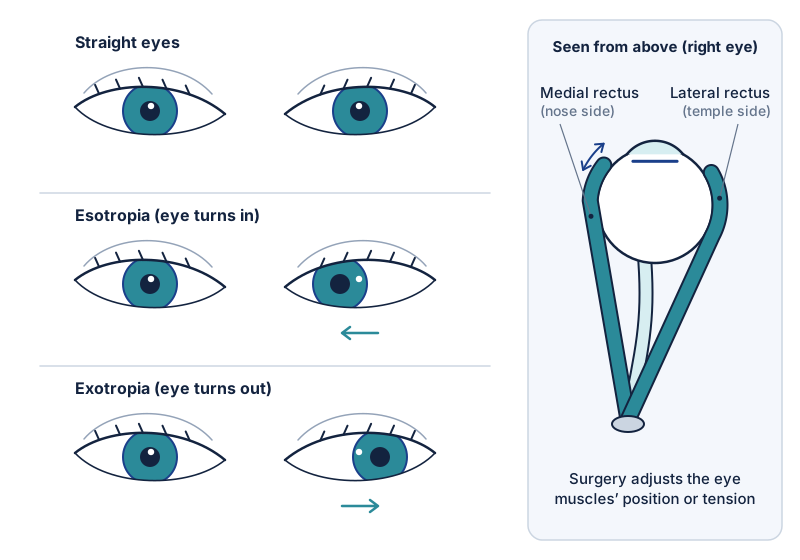
What are the symptoms of Strabismus (Squint)?
- Visible eye misalignment — one eye appears to turn in, out, or vertically
- Double vision (diplopia) — more common in adults with acquired squint
- Head tilt or turn to control double vision
- Closing or covering one eye to eliminate double vision
- Poor depth perception
- In children — amblyopia, or the child does not appear to notice double vision due to suppression
What causes Strabismus (Squint)?
- Childhood esotropia — accommodative esotropia (related to hyperopia), infantile esotropia
- Nerve palsy — third, fourth, or sixth cranial nerve
- Thyroid eye disease (Graves' ophthalmopathy) causing restrictive squint
- Decompensated phoria — a previously controlled tendency to squint breaking down with fatigue, illness, or age
- Mechanical restriction — following trauma, orbital fracture, previous surgery
How is Strabismus (Squint) diagnosed?
Orthoptic assessment: cover test, prism cover test, ocular motility examination, assessment of binocular function and diplopia. Neuroimaging where nerve palsy is suspected.
How is Strabismus (Squint) treated?
Glasses may fully correct an accommodative esotropia. Prisms can neutralise diplopia in selected patients. Botulinum toxin (Botox) injections into the extraocular muscles may be used as primary treatment or pre-operatively. Surgical realignment of the eye muscles (recession and/or resection) is the definitive treatment for most forms of strabismus.
Squint SurgeryHow is this managed in Yorkshire?
Adult and paediatric squint surgery is a core fellowship skill here. Private adult surgery at Spire Elland starts from £4,000 (July 2026). Children: paediatric ophthalmology clinics via 01422 324000 or Newmedica 01274 940 519.
Frequently asked questions
Does strabismus surgery cure lazy eye?
No. Amblyopia (lazy eye) is treated with glasses and patching or drops. Surgery aligns the eyes but does not replace amblyopia treatment, which is most effective in young children.
Can a squint come back after surgery?
Yes, sometimes. Eyes can drift again as children grow or in adults over time. Further surgery or prism glasses may be needed. Regular follow-up helps catch changes early.
Can a squint be corrected in adults?
Yes. Squint treatment is suitable for adults as well as children. Adults commonly seek correction for double vision, a long-standing cosmetic eye turn, or a squint acquired after a nerve palsy or thyroid eye disease. Mr Mohyudin assesses and surgically treats adult strabismus.
What causes a squint?
Causes include childhood esotropia (often related to long-sightedness), cranial nerve palsies, thyroid eye disease, and decompensation of a previously controlled squint with age or fatigue. Mechanical restriction following trauma or surgery can also be responsible. An orthoptic assessment identifies the underlying cause.
How is a squint treated?
Treatment depends on the cause. Glasses may fully correct an accommodative squint, and prisms can neutralise double vision. Botulinum toxin injections are used in selected cases. Surgical realignment of the eye muscles (recession and/or resection) is the definitive treatment for most forms of strabismus.
Book a Consultation
Ask Spire Elland Hospital about current private consultation availability. A GP referral is not required for self-pay.
Book at Spire Elland ↗ Call 01422 324000Routine consultation suitable
Related conditions
Self-Assessment Tool
Not sure if you need to be seen? Take our symptom checker.
Start self-assessment →