Quick answer
Astigmatism is a common refractive error in which the cornea or lens is not perfectly spherical, shaped more like a rugby ball than a football. This causes light to focus at two different points rather than one, producing blurred or distorted vision at all distances. Most cases are mild and easily corrected.
What is Astigmatism?
Astigmatism is one of the most common refractive errors, affecting an estimated 30–40% of adults to some degree. It occurs when the cornea or lens is not perfectly spherical — instead of being round like a football, it is shaped more like a rugby ball. This causes light to focus at two different points rather than one, producing blurred or distorted vision at all distances. Most cases of astigmatism are mild and easily corrected.
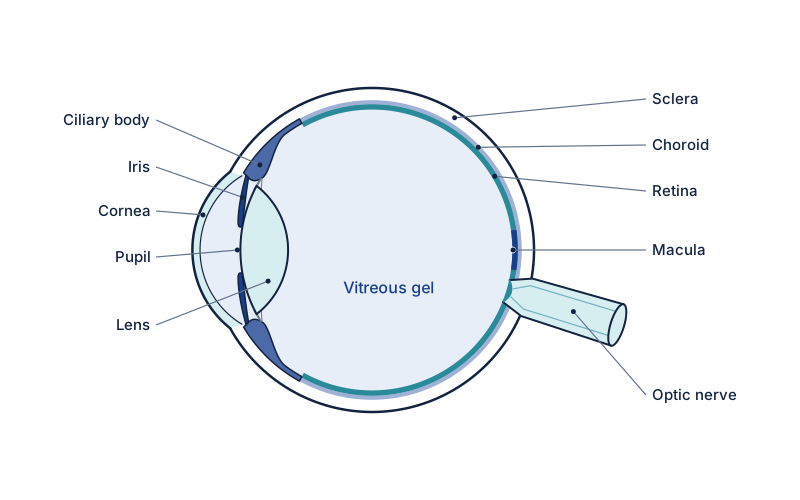
What are the symptoms of Astigmatism?
- Blurred or distorted vision at all distances
- Eye strain and headaches, particularly after prolonged reading or screen use
- Squinting in an attempt to see more clearly
- Difficulty with night vision — halos around lights
- Asthenopia (eye fatigue)
What causes Astigmatism?
- Irregular curvature of the cornea (corneal astigmatism) — the most common type
- Irregular curvature of the crystalline lens (lenticular astigmatism)
- Corneal scarring following injury or infection
- Keratoconus — a progressive thinning of the cornea
How is Astigmatism diagnosed?
Refraction assessment during a standard eye examination. Corneal topography may be used to map the exact shape of the corneal surface in more complex cases.
How is Astigmatism treated?
Mild astigmatism may need no treatment. Spectacles or toric contact lenses correct the irregular focus. Toric intraocular lenses (IOLs) at the time of cataract surgery can address pre-existing astigmatism. Laser vision correction (LASIK, LASEK) reshapes the cornea.
How is this managed in Yorkshire?
Glasses and contact lenses treat most astigmatism. At cataract surgery, a toric IOL is a private option discussed at Spire Elland. See the intraocular-lens guide.
Frequently asked questions
What are the symptoms of astigmatism?
Astigmatism causes blurred or distorted vision at all distances. Other symptoms include eye strain and headaches, particularly after prolonged reading or screen use, squinting to see more clearly, difficulty with night vision such as halos around lights, and asthenopia (eye fatigue). Most cases are mild and easily corrected.
What causes astigmatism?
Astigmatism most commonly results from an irregular curvature of the cornea (corneal astigmatism). It can also arise from an irregular curvature of the crystalline lens (lenticular astigmatism), corneal scarring following injury or infection, or keratoconus, a progressive thinning of the cornea. The cornea or lens is not perfectly spherical.
How is astigmatism treated?
Mild astigmatism may need no treatment. Spectacles or toric contact lenses correct the irregular focus. Toric intraocular lenses (IOLs) fitted at the time of cataract surgery can address pre-existing astigmatism. Laser vision correction, such as LASIK or LASEK, reshapes the cornea to correct the irregular focus.
Book a Consultation
Ask Spire Elland Hospital about current private consultation availability. A GP referral is not required for self-pay.
Book at Spire Elland ↗ Call 01422 324000Routine consultation suitable
Related conditions
Self-Assessment Tool
Not sure if you need to be seen? Take our symptom checker.
Start self-assessment →