Quick answer
Ptosis is the medical term for a drooping upper eyelid. When the lid drops far enough to encroach on the pupil, it restricts the upper visual field and can cause eye strain, brow ache, a compensatory chin lift and difficulty driving or reading. It is corrected surgically by tightening or reattaching the eyelid-lifting muscle.
On this page
Ptosis — the medical term for a drooping upper eyelid — sits on the boundary between functional and aesthetic ophthalmic surgery. When the eyelid drops far enough to encroach on the pupil, it restricts the upper visual field and can cause real symptoms: eye strain, brow ache, compensatory chin lift, and difficulty driving or reading.
Key facts at a glance
- Aponeurotic (age-related) ptosis is the most common cause
- Standard adult repair: levator advancement under local anaesthetic
- Patient usually awake to fine-tune the lid height
- Often combined with upper-lid blepharoplasty for excess skin
- Most patients return to office work after 7-10 days
- Often covered by insurance when vision is impaired
What causes a drooping eyelid?
- Aponeurotic (age-related) ptosis — the most common cause. The levator muscle's tendon stretches or detaches over time.
- Congenital ptosis — present from birth, often due to a poorly developed levator muscle.
- Neurogenic ptosis — third cranial nerve palsy, Horner's syndrome, myasthenia gravis.
- Mechanical ptosis — caused by the sheer weight of excess upper-lid skin, a lid lesion or scarring.
- Traumatic ptosis — following injury or previous eye surgery.
How is ptosis assessed?
A proper oculoplastic assessment is essential before surgery. The consultant measures the height of the eyelid relative to the pupil (MRD1), the levator muscle function, the position of the upper-lid crease, and the symmetry between the two sides. Photographs are taken. Visual field testing is sometimes done to document the functional impairment, which is also important for insurance approval.
Surgical options
- Levator advancement / reinsertion — the standard adult procedure, performed under local anaesthetic, with the patient sitting up during surgery to fine-tune the height.
- Müller's muscle conjunctival resection (MMCR) — a posterior approach, ideal for mild ptosis with good phenylephrine response.
- Frontalis sling — used when levator function is very poor, particularly in congenital ptosis. The eyelid is suspended from the brow muscle.
- Often combined with upper-lid blepharoplasty if there is also excess skin.
Recovery
- Bruising and swelling for 1–2 weeks, peaking at day 2–3.
- Cold compresses, ointment to the wound and avoidance of heavy lifting for the first week.
- Stitches are usually removed at one week.
- Most patients return to office work after 7–10 days.
- Final cosmetic result settles over 2–3 months as residual swelling resolves and the lid crease defines.
Who should skip private ptosis surgery?
Skip a private booking if the lid drop is sudden with double vision or a small pupil — that can be a nerve palsy or Horner’s syndrome and needs urgent medical assessment, not a cosmetic slot. Skip surgery if you have not had levator function measured. Skip combining it with a large aesthetic blepharoplasty if untreated dry eye is already severe. Children with congenital ptosis need a paediatric ophthalmology plan because amblyopia risk, not the photograph, sets the timing.
How is ptosis surgery arranged in Yorkshire with Mr Mohyudin?
Mr Mohyudin is fellowship-trained in oculoplastics. Private adult ptosis repair is at Spire Elland Hospital, typically under local anaesthetic so lid height can be set with you sitting up. Starting self-pay prices are from £2,500 per lid (practice figure, July 2026) — confirm after examination. Huddersfield and Halifax patients are about ten minutes away; Bradford consultations can start at Newmedica Cleckheaton. NHS funding is possible when visual field loss is documented; if you meet criteria, private care is optional.
Is ptosis the same as hooded eyelids?
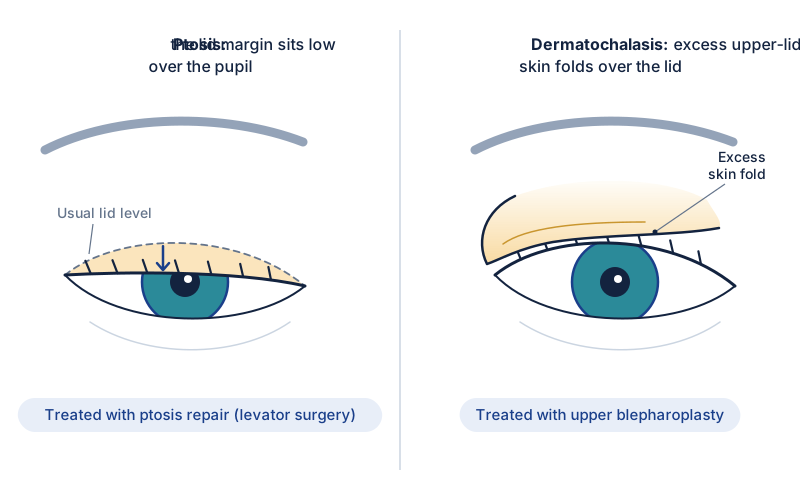
No. Dermatochalasis is extra upper-lid skin. Ptosis is a low lid margin — the edge that holds the lashes — because the levator muscle or its tendon is not lifting. You can have both. A blepharoplasty that only removes skin will not lift a true ptosis, and a ptosis repair that ignores a heavy skin fold can still look hooded. The measurements (MRD1 and levator function) decide which operation, or both.
When is congenital ptosis in a child urgent?
When the lid covers the pupil and the child is still in the amblyopia window. That is a visual-development problem, not a cosmetic one. Timing can mean frontalis sling rather than an adult-style levator advancement. Mr Mohyudin’s paediatric fellowship is why children are not simply booked onto an adult local-anaesthetic list. A mild, pupil-clear congenital ptosis may be watched with orthoptic checks rather than rushed to theatre.
What does a useful ptosis consultation include?
The key question is why the eyelid is low. Extra skin, a low eyebrow and a weak or stretched lifting mechanism can look similar in a photograph but need different plans. Describe whether the droop developed gradually, varies through the day or followed an operation. Bring older photographs if the change is difficult to date. A new droop with double vision, a severe headache or a change in pupil size requires urgent assessment.
Before agreeing to an operation, ask how the proposed repair addresses your examination findings and how the other eyelid may appear afterwards. Discuss eye-surface comfort, eyelid closure, symmetry and the possibility of a lid sitting higher or lower than intended. The relevant outcome is not simply a wider-looking eye: comfortable closure and protection of the eye matter too. Ask when the position will be reassessed, because early swelling can make it difficult to judge the final result.
Questions to take to your appointment
- Is the problem the lifting muscle, excess skin, the eyebrow or a combination?
- How could surgery affect dryness or eyelid closure?
- When can the final height be judged?
Frequently Asked Questions
Is ptosis surgery covered by private medical insurance?
When ptosis is causing functional visual impairment — typically when the upper lid covers part of the pupil at rest — most UK private medical insurers will cover the procedure. Pre-authorisation requires documentation including measurements and often a visual field test.
Will I be awake during ptosis surgery?
Most adult ptosis surgery is performed under local anaesthetic with the patient awake, because the surgeon needs you to open and close your eyelid during the operation to set the height precisely. Sedation can be added if you are anxious.
How long do the results of ptosis surgery last?
Results are typically long-lasting — many decades. Recurrence is uncommon but possible, particularly in congenital cases. Aging changes in the face will of course continue, so a small revision in later years is occasionally needed.
Can ptosis surgery and blepharoplasty be done together?
Often yes, when both extra skin and a low lid margin are present. Doing only one leaves the other problem visible. The combined plan is decided after measuring levator function and the skin fold — not from a photograph sent by email.
What if one lid is still lower after surgery?
Small asymmetries are common while swelling settles. A minority need a later adjustment. That possibility is part of consent. Sudden pain, rapidly increasing swelling, or a drop in vision after surgery is not ‘normal bruising’ — contact the hospital.
Sources & further reading
Patient information and guidance supporting this topic. Your own clinical team’s advice takes priority over a general guide.

Mr Mohamed Mohyudin
MBChB BSc MSc FRCOphth CCT — Consultant Ophthalmic Surgeon, Spire Elland Hospital, Yorkshire. GMC 7039600. Humanitarian cataract surgery in Karachi and Islamabad: World Aid Network.
View full credentials →