Quick answer
Adult squint (strabismus) surgery is effective at any age. Mr Mohamed Mohyudin, a fellowship-trained strabismus surgeon in West Yorkshire who has performed more than 500 squint operations, offers private adult squint correction at Spire Elland Hospital near Huddersfield. The operation realigns the eye muscles under general anaesthetic as a day case, improving both appearance and, in many cases, double vision.
On this page
There is a persistent myth that squint surgery is 'just for children'. It is not. Adults with squint — whether longstanding from childhood, or new-onset due to neurological, thyroid or trauma causes — can usually be corrected with modern strabismus surgery, often with excellent cosmetic and binocular results.
Key facts at a glance
- Treatable at any age — it is never 'too late' to correct an adult squint
- Day-case operation, usually under general anaesthetic
- Performed by a fellowship-trained strabismus specialist (500+ squint surgeries)
- Private consultation at Spire Elland Hospital — no GP referral required
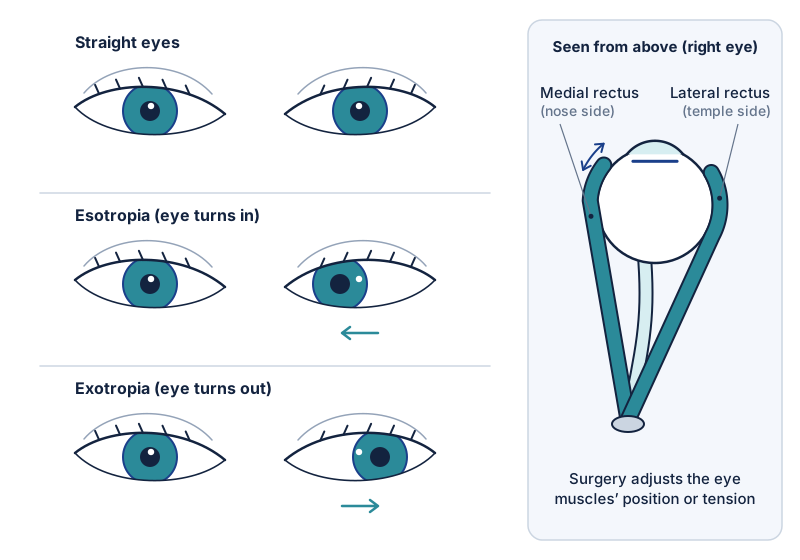
What is adult squint (strabismus)?
Squint, or strabismus, is a misalignment of the eyes — one eye may turn inwards (esotropia), outwards (exotropia), upwards (hypertropia) or downwards (hypotropia). It can be constant or intermittent.
In adults the impact is rarely 'just cosmetic'. Patients commonly describe double vision, eye strain, difficulty making eye contact in conversation or professional settings, and meaningful loss of self-confidence.
Causes of adult squint
- Decompensated childhood squint — a previously controlled squint becoming manifest in adulthood.
- Thyroid eye disease — restrictive strabismus from enlarged extraocular muscles.
- Cranial nerve palsies (third, fourth or sixth nerve) — often from microvascular ischaemia, trauma or, less commonly, intracranial pathology.
- Post-surgical or post-trauma — including following cataract or retinal surgery.
- Convergence insufficiency and other neuromuscular causes.
How private strabismus surgery works
Adult squint surgery is a precise, microsurgical operation on the extraocular muscles. The surgeon adjusts the tension and position of one or more of the six muscles attached to each eye to realign the visual axes.
It is performed as a day case, typically under general anaesthetic and usually takes 45–90 minutes per eye depending on the number of muscles addressed. Patients go home the same day with eye drops and clear written instructions.
Recovery and outcomes
- Eye redness for 2–6 weeks, fading gradually — the white of the eye returns to normal.
- Most patients return to office work within a week and to driving within 1–2 weeks once double vision (if any) settles.
- Final alignment outcome is assessed at around 8–12 weeks.
- The published success rate for satisfactory alignment in expert hands exceeds 80% from a single operation, with some patients benefitting from a planned secondary adjustment.
Choosing a strabismus surgeon
Strabismus is a true subspecialty — far fewer consultant ophthalmologists actively operate on adult squint than do, say, cataract. Look for fellowship-trained paediatric ophthalmology and strabismus subspecialists. Mr Mohyudin is a member of BIPOSA (the British and Irish Paediatric Ophthalmology and Strabismus Association) and has personally performed more than 500 squint operations.
Who should skip private adult squint surgery?
Skip booking if the squint appeared in hours or days, or if it came with a drooping lid, unequal pupils, or a new severe headache. Those patterns can be a cranial-nerve palsy or worse, and the first job is diagnosis, not a theatre date. Skip muscle surgery while thyroid eye disease is still wet and changing — operating on inflaming muscles is the wrong sequence. Skip an adult private list for a child whose brain is still wiring vision: patching and glasses can still change the outcome.
How does adult squint surgery differ from childhood surgery?
The muscles are the same six muscles. The goals are not. In children the usual aim is to protect binocular development and treat or prevent amblyopia. In adults the usual aims are to reduce double vision, restore a more natural appearance, and sometimes recover a useful field of single vision. Adults can describe the double vision; children often cannot. Adults more often need prisms first, and selected cases use adjustable sutures so the alignment can be fine-tuned when you are awake.
Which adult squints are usually surgical, and which are not?
A long-standing decompensated childhood squint that now shows at work, or a stable post-traumatic misalignment, is often a surgical problem once orthoptics have measured it. A tiny intermittent exotropia that only appears when you are exhausted may be managed with exercises, prisms or watchful waiting. New microvascular sixth-nerve palsies in people with diabetes or high blood pressure often improve over months — operating in week two is usually too soon.
| Situation | Usual first step | Usually not first |
|---|---|---|
| Decompensated childhood squint, tired of appearance or strain | Orthoptics then surgical consult | Buying stronger reading glasses alone |
| Thyroid eye disease, still inflaming | Medical/oculoplastic control of the disease | Early muscle surgery |
| Sudden double vision with vascular risk | Same-day or urgent medical assessment | A cosmetic private slot |
| Child under eight with a constant turn | Paediatric ophthalmology / orthoptics | An adult private day-case list |
How is private adult squint surgery arranged in Yorkshire?
Mr Mohyudin is fellowship-trained in paediatric ophthalmology and strabismus and a BIPOSA member. Private adult operations are at Spire Elland Hospital, Elland Lane, HX5 9EB, usually as a day case under general anaesthetic. Self-pay starts from £4,000 (practice figure, July 2026) — confirm after examination because extra muscles change the quote. No GP referral is needed to book. Call 01422 324000. Huddersfield and Halifax are about ten minutes away; Bradford patients often start at Newmedica in Cleckheaton. NHS strabismus surgery remains appropriate when you meet criteria and can wait.
What should an adult squint assessment resolve before surgery?
An adult consultation should separate three goals: improving alignment, reducing double vision and improving comfort or confidence in everyday situations. These goals are related but are not interchangeable. Explain when double vision occurs, whether it changes with distance or tiredness, and any previous eye-muscle surgery. Old clinic letters and photographs can help the team understand how the alignment has changed.
Ask which non-surgical options are relevant to your pattern of squint and how the expected benefit of surgery will be judged. Glasses, prisms or observation may be appropriate in some circumstances. If surgery is proposed, discuss the possibility of residual or new double vision, an imperfect correction and further treatment. A realistic plan also covers time away from driving or visually demanding work. New-onset double vision needs assessment of its cause before it is treated as a routine cosmetic concern.
Questions to take to your appointment
- Is the main aim alignment, relief of double vision, or both?
- Would a prism trial change the decision?
- How will you assess the result, and when would further treatment be considered?
Frequently Asked Questions
Am I too old for squint surgery?
No. Squint surgery is safe and effective at any adult age, including in patients in their 70s and 80s, provided they are medically fit for a short general anaesthetic. The myth that adult squint cannot be corrected is one of the most common reasons patients live unnecessarily with a treatable condition.
Will squint surgery cure my double vision?
In most cases, yes — but the answer depends on the cause and how long the squint has been present. A thorough orthoptic assessment with prism testing is required before surgery to predict the outcome accurately. In selected cases adjustable suture techniques are used to fine-tune the result.
How much does private adult squint surgery cost?
Typical UK self-pay pricing for private adult strabismus surgery ranges from approximately £4,500 to £7,500 per eye depending on the number of muscles operated on, anaesthesia and hospital. All major UK insurers cover medically indicated strabismus surgery.
Does private adult squint surgery at Spire Elland start from £4,000?
Yes — from £4,000 is the published self-pay floor for this consultant at Spire Elland, last checked July 2026. It is a starting package, not a personal quote. More muscles, bilateral surgery, or adjustable sutures can cost more. Typical UK self-pay ranges quoted elsewhere often sit higher. Insurers usually cover medically indicated strabismus surgery after pre-authorisation.
Will I need a second operation?
Some patients do. Alignment can drift, and a planned secondary adjustment is part of honest counselling, not a failed first attempt. Published satisfactory-alignment rates in expert hands exceed 80% from a single operation; that is not a guarantee for your eye. Final alignment is judged around 8–12 weeks, not the day you go home.
Sources & further reading
Patient information and guidance supporting this topic. Your own clinical team’s advice takes priority over a general guide.

Mr Mohamed Mohyudin
MBChB BSc MSc FRCOphth CCT — Consultant Ophthalmic Surgeon, Spire Elland Hospital, Yorkshire. GMC 7039600. Humanitarian cataract surgery in Karachi and Islamabad: World Aid Network.
View full credentials →