Quick answer
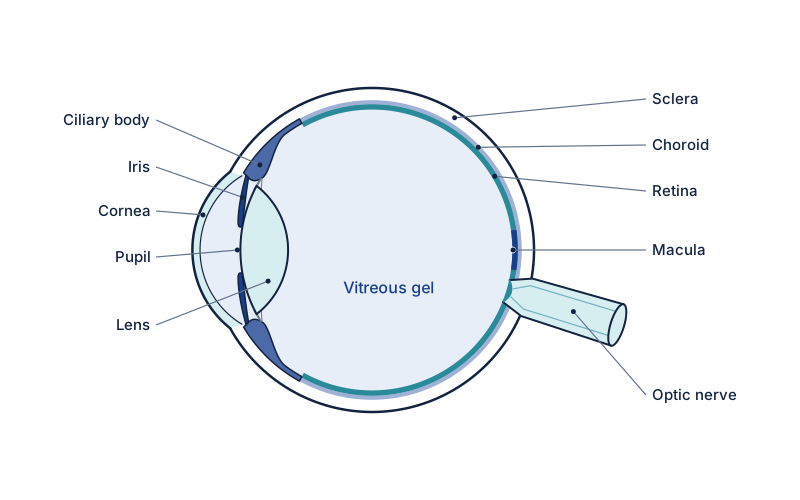
Myopia, or short-sightedness, is the most common refractive error, occurring when the eyeball is slightly too long from front to back so light focuses in front of the retina rather than on it. Distant objects appear blurred while near objects are seen clearly. High myopia carries an increased risk of retinal complications.
What is Myopia (Short-Sightedness)?
Myopia, or short-sightedness, is the most common refractive error worldwide and its prevalence is increasing rapidly, particularly in young people. It occurs when the eyeball is slightly too long from front to back, causing light to focus in front of the retina rather than on it. Distant objects appear blurred while near objects are seen clearly. High myopia (greater than -6 dioptres) is associated with an increased risk of retinal complications including retinal detachment, macular degeneration and glaucoma.
What are the symptoms of Myopia (Short-Sightedness)?
- Difficulty seeing distant objects clearly — road signs, blackboards, TV screens
- Clear vision for reading and close work
- Squinting to try to see at distance
- Headaches from the effort of trying to focus
- Eye strain, particularly after driving
What causes Myopia (Short-Sightedness)?
- Excessive axial length of the eyeball — the most common mechanism
- Steeper-than-normal corneal curvature
- Strong genetic component — risk significantly increased if one or both parents are myopic
- Environmental factors — prolonged near work and limited outdoor time in childhood
How is Myopia (Short-Sightedness) diagnosed?
Refraction assessment, measuring glasses prescription. Cycloplegic refraction (with dilating drops) is used in children to obtain an accurate measurement. Axial length measurement and fundus examination are important in high myopia.
How is Myopia (Short-Sightedness) treated?
Spectacles and contact lenses are the standard correction. Orthokeratology (overnight contact lenses) and low-dose atropine drops are established myopia control strategies in children. In adults, laser vision correction (LASIK, LASEK) or implantable collamer lenses (ICL) can reduce or eliminate glasses dependence. People with high myopia should have annual dilated fundus examinations.
How is this managed in Yorkshire?
Children with myopia and squint or amblyopia risk belong in the paediatric clinic. Adult high myopes having cataract surgery need a retina-aware plan; the implant choice is in the lens guide, not a ‘near me’ advert.
Frequently asked questions
What are the symptoms of myopia?
The main symptom is difficulty seeing distant objects clearly, such as road signs, blackboards and TV screens, while reading and close work remain clear. People often squint to see at distance and may experience headaches from the effort of focusing, along with eye strain, particularly after driving.
What causes short-sightedness?
Myopia most commonly results from the eyeball being excessively long (axial length), and sometimes from a steeper-than-normal corneal curvature. There is a strong genetic component, with risk significantly increased if one or both parents are myopic. Environmental factors such as prolonged near work and limited outdoor time in childhood also contribute.
How is myopia treated?
Spectacles and contact lenses are the standard correction. In children, orthokeratology (overnight lenses) and low-dose atropine drops are established myopia control strategies. In adults, laser vision correction (LASIK, LASEK) or implantable collamer lenses (ICL) can reduce or eliminate glasses dependence. People with high myopia need annual dilated fundus examinations.
Book a Consultation
Ask Spire Elland Hospital about current private consultation availability. A GP referral is not required for self-pay.
Book at Spire Elland ↗ Call 01422 324000Routine consultation suitable
Related conditions
Self-Assessment Tool
Not sure if you need to be seen? Take our symptom checker.
Start self-assessment →