Quick answer
Age-related macular degeneration (AMD) is a progressive loss of central vision caused by damage to the macula, the small central area of the retina responsible for sharp, detailed vision. It is the leading cause of severe vision loss in people over 50. There are two forms: dry AMD (gradual) and wet AMD (faster, treatable).
What is Age-Related Macular Degeneration (AMD)?
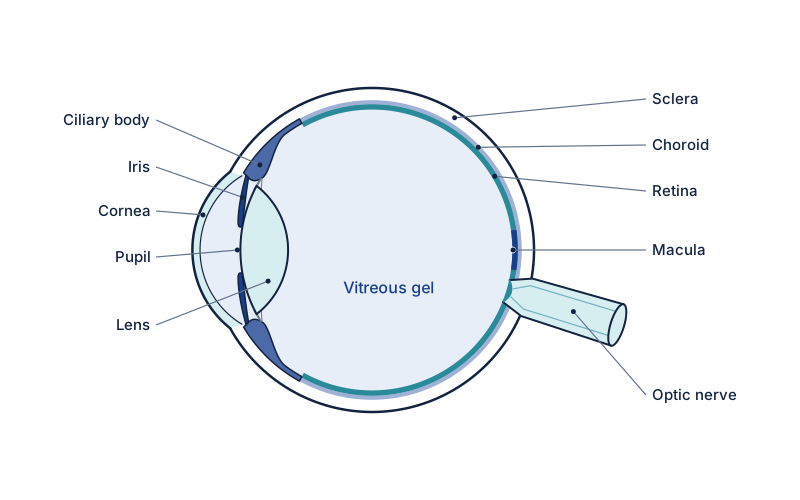
Age-related macular degeneration (AMD) is the leading cause of severe vision loss in people over 50 in the developed world. It affects the macula — the small central area of the retina responsible for sharp, detailed vision used in reading, driving and recognising faces. AMD does not cause complete blindness, as peripheral vision is preserved, but the loss of central vision can have a profound impact on quality of life. There are two forms: dry AMD (gradual) and wet AMD (faster, treatable).
What are the symptoms of Age-Related Macular Degeneration (AMD)?
- Gradual blurring of central vision
- Difficulty reading, particularly in dim light
- Distortion — straight lines appearing wavy or bent (Amsler grid test)
- Objects appearing smaller or further away than they are
- A blank or dark spot in the centre of vision (advanced AMD)
- Colours appearing less vivid
What causes Age-Related Macular Degeneration (AMD)?
- Age — the single greatest risk factor; risk increases significantly over 70
- Smoking — doubles the risk of AMD
- Family history and genetic factors
- Cardiovascular disease and high blood pressure
- UV light exposure
How is Age-Related Macular Degeneration (AMD) diagnosed?
Fundus examination, optical coherence tomography (OCT), fundus fluorescein angiography (FFA) and OCT-angiography to distinguish dry from wet AMD and to assess for new vessel growth.
How is Age-Related Macular Degeneration (AMD) treated?
Dry AMD has no curative treatment; AREDS2 nutritional supplements slow progression in intermediate AMD. Wet AMD is treated with intravitreal anti-VEGF injections (ranibizumab, aflibercept, bevacizumab) — these can stabilise and sometimes improve vision if started promptly. Regular monitoring is essential.
How is this managed in Yorkshire?
Mr Mohyudin will look at the macula before cataract or eyelid surgery and refer wet AMD for anti-VEGF. Yorkshire patients with new distortion should not wait for a self-pay diary — use optometrist urgent pathways or eye casualty.
Frequently asked questions
Do eye injections hurt?
The eye is numbed first, so most people feel only mild pressure rather than pain. The eye can feel gritty or look red for a day or two afterwards.
How often will I need eye injections?
It is usually a course rather than a single injection, often starting monthly and then spaced out depending on how your eye responds, guided by regular scans.
Do eye injections improve vision?
They aim to stabilise vision and prevent further loss, and many people also see some improvement. Starting treatment promptly gives the best chance of a good result.
What are the early symptoms of macular degeneration?
Early signs include gradual blurring of central vision and difficulty reading, particularly in dim light. Straight lines may appear wavy or bent on an Amsler grid, objects can look smaller or further away, and colours may seem less vivid. Advanced AMD may cause a blank or dark spot in central vision.
Can macular degeneration be treated?
Treatment depends on the type. Dry AMD has no curative treatment, though AREDS2 nutritional supplements can slow progression in intermediate AMD. Wet AMD is treated with intravitreal anti-VEGF injections (ranibizumab, aflibercept or bevacizumab), which can stabilise and sometimes improve vision if started promptly. Regular monitoring is essential.
How is macular degeneration diagnosed?
Diagnosis involves a fundus examination alongside optical coherence tomography (OCT), fundus fluorescein angiography (FFA) and OCT-angiography. These tests help distinguish dry from wet AMD and assess for new vessel growth, which guides treatment. Because wet AMD is time-sensitive, prompt assessment is important to protect central vision.
Can Mr Mohyudin give the eye injections?
No. Intravitreal anti-VEGF is a medical-retina service. He will not take that work on as a side job during a cataract package.
Book a Consultation
Ask Spire Elland Hospital about current private consultation availability. A GP referral is not required for self-pay.
Book at Spire Elland ↗ Call 01422 324000Prompt assessment recommended
Related conditions
Self-Assessment Tool
Not sure if you need to be seen? Take our symptom checker.
Start self-assessment →